
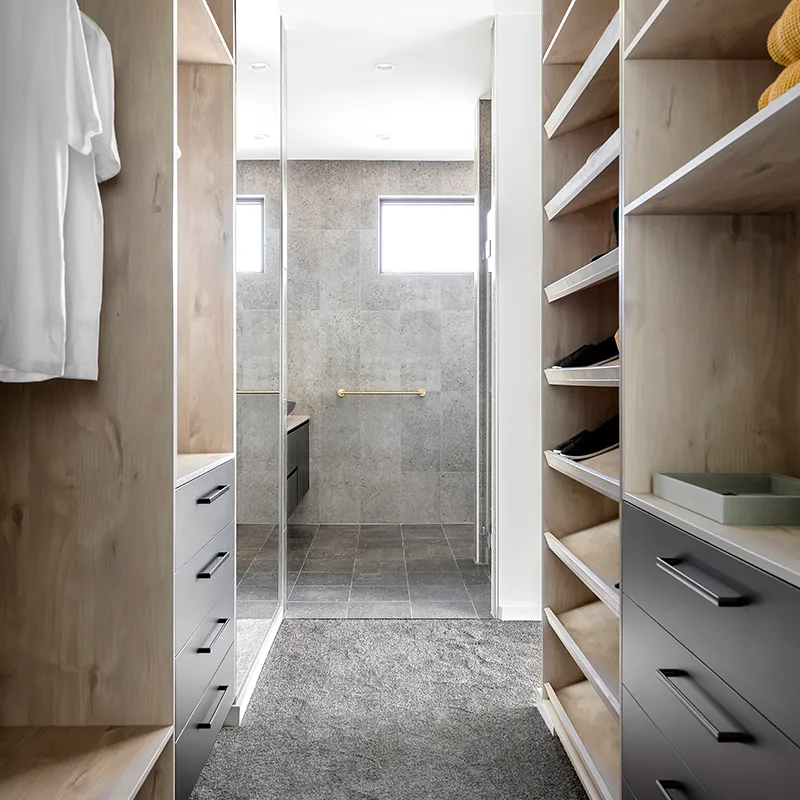
Both a walk-in robe and a well-designed built-in wardrobe can transform how you store and access your clothing. The right choice depends on your bedroom size, how you use the space, and what you're willing to trade off. This guide covers the practical differences, the costs, and how to decide.
What Is a Walk-in Robe?
A walk-in robe (WIR) is a dedicated room — or a very large alcove — with cabinetry on multiple walls. The defining feature is that you enter the space to dress, rather than accessing storage from outside the wardrobe. Walk-in robes typically have hanging rails on two or three sides, full-height shelving, drawer stacks, and often a central island bench for folding and accessory storage.
The minimum functional walk-in robe is approximately 2m x 2m. Anything smaller starts to feel cramped once cabinetry is installed on two walls. The ideal size for a generous WIR with an island is 2.4m x 3.6m or larger.
What Is a Built-in Wardrobe?
A built-in wardrobe occupies an alcove or a section of wall, accessed by sliding doors, hinged doors, or open (robes without doors). The storage is accessed from within the bedroom rather than by entering a separate space. A well-designed built-in wardrobe can hold as much as a walk-in robe of the same footprint, because the cabinetry uses the full depth of the space efficiently.
Built-in wardrobes work in smaller bedrooms where a walk-in robe isn't feasible, and they're appropriate for all bedrooms in a home — not just the master.
Walk-in Robe: Advantages and Limitations
Advantages:
- Superior visual organisation — you can see everything at once
- Dressing area separate from the sleeping area (less disturbance if partners have different schedules)
- Feels like a luxury amenity — a significant feature for resale
- Better ventilation and lighting options for the wardrobe itself
Limitations:
- Requires significant floor space — typically at the cost of bedroom size or an adjacent room
- Higher cost than a built-in wardrobe of equivalent storage
- Requires dedicated lighting and ventilation in the wardrobe room
Built-in Wardrobe: Advantages and Limitations
Advantages:
- Efficient use of space — works in any sized bedroom
- Lower cost per square metre of storage than a walk-in robe
- Less disruptive installation — no structural changes typically required
- Can accommodate more storage per metre than a walk-in robe if the depth is used properly
Limitations:
- Less visual impact — doesn't feel like an amenity in the way a WIR does
- Sliding door wardrobes can only access half the opening at any one time
- Less opportunity for internal lighting and display
What Perth Homeowners Are Choosing in 2026
In Perth's prestige suburbs — Nedlands, Applecross, Dalkeith, Cottesloe — the walk-in robe is close to standard in master bedrooms. Buyers at the $1.5M+ price point expect it, and it's become a significant point of comparison at property inspections.
For secondary bedrooms — children's rooms, guest rooms, study with a daybed — built-in wardrobes remain the practical and economical choice. We regularly design WIRs for master bedrooms and built-in wardrobes for every other bedroom in a coordinated whole-home project.
The Cost Difference
A well-designed built-in wardrobe in a standard bedroom alcove (typically 2.4m wide x 600mm deep) costs roughly $3,500–$8,000 depending on the internal configuration and finish. A walk-in robe with full cabinetry, island bench, and lighting typically starts at $12,000 and can run to $30,000+ for a large, fully specified master dressing room.
For a free consultation on your wardrobe project — built-in or walk-in — book a time online or call 0417 151 309. We serve all Perth suburbs from our Carlisle workshop.