
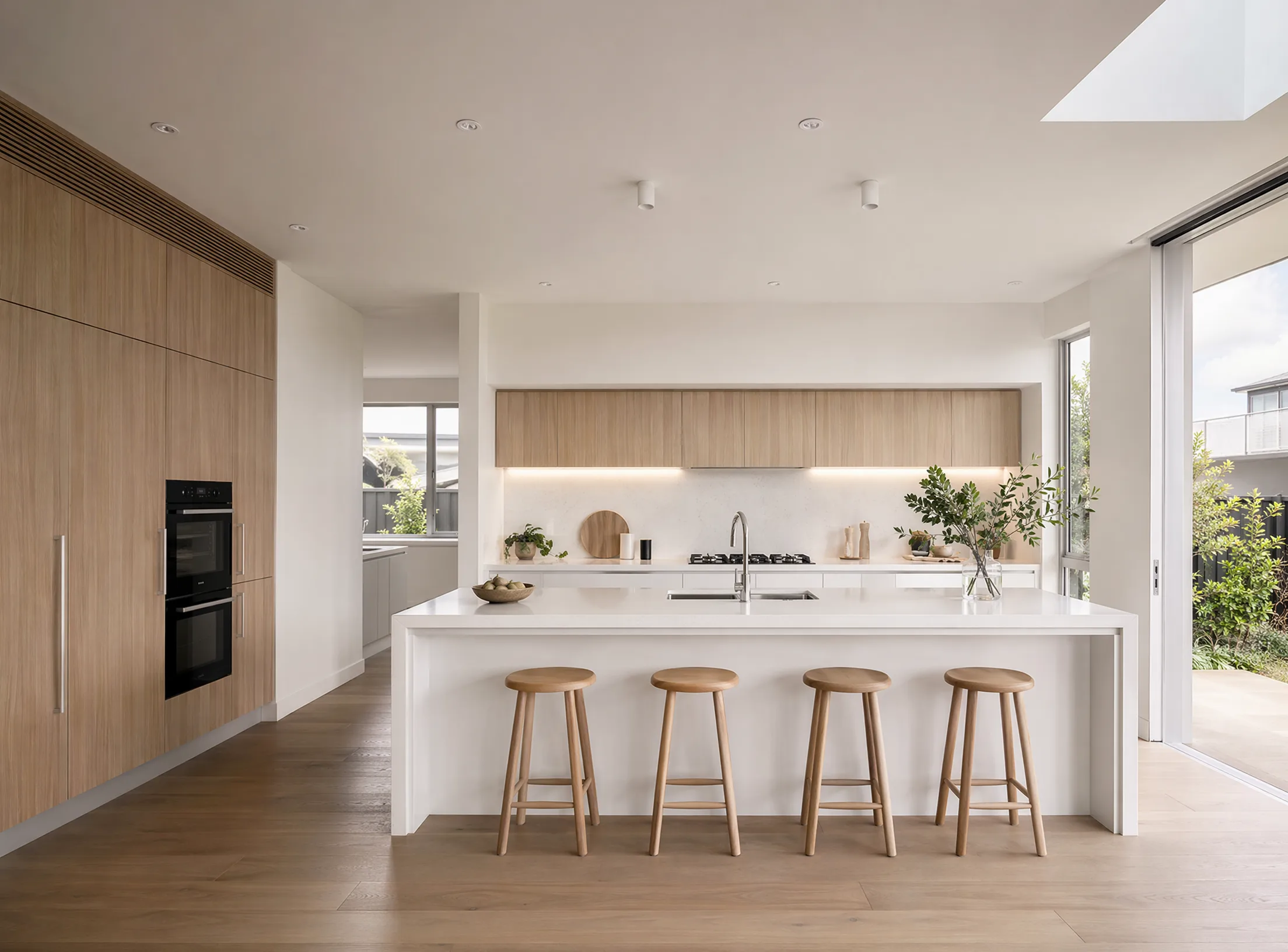
The material your cabinets are made from determines how long they last, how they look, and how they perform in Perth's climate. It also determines a significant chunk of the cost. This guide covers the main options — what they are, what they're good for, and where they fall short.
Particleboard (Chipboard)
The most common substrate used in flat-pack and mid-range custom cabinetry. Particleboard is made from wood chips and resin, pressed into sheets. It's dimensionally stable when dry, takes a melamine or laminate face well, and is cost-effective to manufacture.
Where it works well: Dry interior spaces — overhead kitchen cabinets, wardrobe carcasses, bedroom storage.
Where it struggles: Any area with moisture exposure. The under-sink cabinet, dishwasher surrounds, and bathroom vanities in humid bathrooms are all risk zones. Particleboard that gets wet swells and doesn't recover. In Perth's coastal suburbs where sea air brings elevated humidity, this is a real-world problem that shortens cabinet life significantly.
What to look for: Board thickness matters. Flat-pack cabinets typically use 16mm. Quality custom cabinetry uses 18mm or 33mm, which is noticeably more rigid and durable.
MDF (Medium Density Fibreboard)
MDF is made from fine wood fibres and resin, producing a denser, smoother sheet than particleboard. It takes paint exceptionally well, which makes it the substrate of choice for painted and lacquered cabinet doors.
Where it works well: Painted door profiles — shaker, beaded, flat panel. The smooth surface means no grain telegraphing through the paint, and the dense composition holds routed profiles cleanly.
Where it struggles: MDF is heavier than particleboard and similarly vulnerable to moisture. It's also more expensive. For carcasses (the box structure of the cabinet), MDF is generally overkill — the extra cost doesn't translate to proportional benefit over quality particleboard.
Melamine
Melamine isn't a substrate — it's a surface finish. A melamine sheet is particleboard or MDF with a thermally fused paper-and-resin coating. The coating is hard, cleanable, and resistant to light moisture and everyday wear.
Melamine finishes are available in an enormous range of colours and textures, including realistic timber grains and stone effects. For a clean, contemporary kitchen in Perth's mid-to-upper market, a well-specified melamine door in a matte finish is often indistinguishable at a glance from a painted MDF door — at considerably lower cost.
Polyurethane (PU / 2-Pack Lacquer)
Polyurethane-finished doors are MDF or particleboard doors that have been spray-painted with a catalysed lacquer, then sanded and polished to a smooth, seamless finish. The result is a surface that looks and feels like high-end automotive paint — whether in a high gloss or satin matte.
The advantages: Seamless finish with no visible substrate, available in any colour, highly resistant to UV fading, cleanable with a damp cloth. The finish used in the majority of high-end Perth kitchen renovations.
The trade-off: Higher cost than melamine. If damaged (chipped or scratched), repair requires a professional respray rather than a simple touch-up.
Solid Timber
True solid timber cabinet doors — typically in species like oak, ash or blackbutt — are the premium choice. They offer unique grain character, can be refinished if damaged, and bring warmth that no manufactured board can fully replicate.
The reality for Perth kitchens: Solid timber moves with humidity. It expands and contracts with the seasons. In a well-designed door with proper allowances, this movement is managed. In a poorly specified door, it leads to warping and cracking. For Perth's variable humidity (dry summers, humid coastal winters), timber specification requires care.
Timber veneer — a thin layer of real timber applied over a stable MDF or particleboard substrate — gives most of the aesthetic of solid timber without the movement risk. This is what most Perth cabinetmakers use for "timber" doors.
Compact Laminate
Compact laminate (like Formica Surround or Laminex Aquapanel) is a through-coloured laminate sheet without a substrate — the laminate is the panel. It's highly moisture-resistant, extremely durable, and available in contemporary colours and textures.
Compact laminate is the material of choice for bathroom vanities and laundry cabinetry in Perth homes, particularly in coastal suburbs where moisture resistance is critical. It doesn't swell, doesn't delaminate, and can be used for both carcasses and door faces.
What PCS Cabinets Recommends
For kitchen carcasses: 18mm moisture-resistant particleboard as standard, with compact laminate for any under-sink or dishwasher surrounds. For doors: melamine for budget-conscious projects, polyurethane lacquer for premium finishes, timber veneer for warmth and character. For bathrooms and laundries: compact laminate throughout.
The right combination depends on your budget, the specific rooms involved, and how long you plan to stay in the home. Our design team will walk through the options with you at your free consultation.
Book a free consultation or call 0417 151 309.